Although the Centre does not currently function as a wildlife rehabilitation facility, we do have emergency medical rehabilitation facilities in place to supply emergency first aid measures when needed. We have the special knowledge and skill that is needed to properly treat injured specialized species.
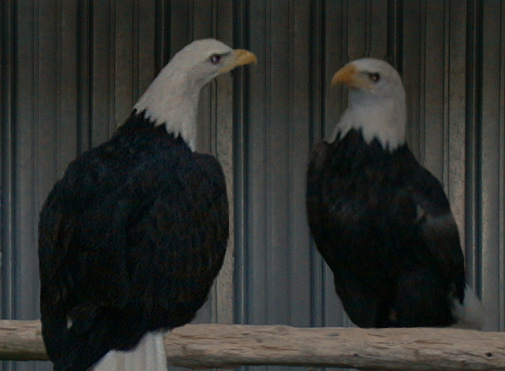
Over the years, we have provided sanctuary to numerous birds of prey that have been injured in the wild. Unfortunately for some of these birds their injuries are so severe that they cannot be released back into the wild. Rather than being euthanized they are sent to our Centre and placed into captive propagation programs so that they may have a second chance to live fulfilling and productive lives while simultaneously doing their part to ensure that their species can never become extinct.
Many rehabilitation facilities are only capable of handling a limited number of birds at any given time and this forces them to find suitable homes for many non-releasable birds. Some are incapable of adapting to the stress of a zoo experience and the Centre’s isolated, stress free environment is ideal.
We always attempt to place them into breeding pairs, thereby giving their life meaning. Many of our biggest success stories are the result of captive breeding birds that have come from rehabilitation centres.
The offspring of these animals are now used in educational programs, not only at our Centre but also at zoological facilities around the world.
If you would like additional information about how the Centre provides a second chance to injured birds of prey please feel free to contact us with any questions you may have.
People sometimes wonder why captive propagation programs are important. The single most important reason for the captive propagation of wildlife is that it acts as an insurance policy against extinction. No species that has a stable captive breeding population can ever truly become extinct.
Two well known examples of successes are those set by the captive propagation of American Buffalo and the California Condor. Both of these species were on the edge of extinction in the wild but were saved by the combination of captive breeding and release programs, in addition to intensive habitat conservation efforts.
Imagine the North American skies darkened by their sheer numbers and the roar of the thunderous beats from the wings of billions of Passenger pigeons. Unique to the North American continent, they had the largest single population number of any bird species on Earth. It was thought they could never go extinct.
Such a wondrous spectacle would actually be possible again today; if only someone had thought to properly breed this species in captivity. Instead, the last confirmed wild bird is thought to have been shot in 1900. Martha, thought to be the last passenger pigeon, died on September 1, 1914, at the Cincinnati Zoo.
Loss of genetic diversity is another ominous issue facing many endangered species today. Captive breeding programs can assist with this problem by injecting healthy new genes into small and isolated genetic pools. Increasingly, many fragmented wildlife populations will require human intervention in order to maintain viable and genetically diverse populations in the future.
Another benefit of captive breeding is the opportunity to observe and research animal breeding behaviour. Many species are very difficult to observe in the wild and being able to fully understand their reproductive biology can be vital in assisting conservation efforts in unimaginable ways.
Finally, public education. Being able to actually see and experience being in the presence of live animals in zoos and similar reputable facilities inspires people to have a greater understanding and appreciation for the world in which we live.
If we as human beings cannot appreciate the non-human life we share our would with and learn to live in harmony with it then this will be to our own severe detriment. Quite likely we will find it is our turn to be on the very short (by then) endangered species list!
A clutch of Snowy Owlets (Bubo scandiacus) being hand fed. This is done to allow the parents to nest again and then these young are reintroduced to the parents.
The Centre’s captive propagation (breeding programs) have been highly successful over the years we have been in operation. Over 30 birds of prey and bat species have successfully produced young at the Centre. We have also successfully bred many other species including bush babies (Galago moholi), and even a wide variety of arthropods (insects).
Some of the better known species that have bred at the Centre include Bald Eagles, Peregrine Falcons, Snowy Owls and fruit bats. However, we are very proud of some of the more difficult to breed species that have produced young for us. Ferruginous hawks, Swainson’s hawks, Prairie falcons and even Vampire Bats (Desmodus rotundus) are but a few examples of traditionally difficult species that have thrived at the Centre.
We strive to provide our breeding animals with a “simulated wild environment” which entails ensuring as little human interference and disturbance as possible. Many of our most outstanding successes propagating specialized species have been with animals that were injured in the wild and now thrive in the safety and seclusion at our Centre.
Some of the animals born at the Centre are used in captive propagation on-site, or in our educational programs off-site. Others are placed in other similar zoological or educational facilities, as is determined to be the best choice to further their species survival on earth. We DO NOT sell animals to the pet trade! We feel very responsible for ALL of the animals at our Centre and as such take great care to ensure that they are placed in safe, high quality reputable facilities that share to ensure their contribution to conservations efforts worldwide.
Unfortunately at the present time we do not directly release animals born at the Centre back into the wild. This is simply not financially possible for our facility as of yet. Hopefully we will be able to do this in the future, and of course if requested we will provide animals for wild release programs. This is after all what it is all about. Restoring the balance of nature!
We have found that our Centre’s best contributions to worldwide conservation efforts are in our public education efforts and furthering the captive propagation of specialized species themselves; thereby ensuring their very survival on earth.
© 2024 The Centre for the Conservation of Specialized Species.
Canadian Charitable Number: 89891 4452 RR0001
Unauthorized use and/or duplication of this material without the expressed and written permission of the owner is strictly prohibited. Excerpts and links may be used, provided that full and clear credit is given to The Centre for the Conservation of Specialized Species, with appropriate and specific direction to the original content.